
THE PROS AND CONS OF USING YOUR
HEALTH INSURANCE
FOR THERAPY
UNDERSTAND YOUR OPTIONS | CHOOSE WHAT'S RIGHT FOR YOU
Using insurance can make therapy more affordable—but it can also impact your privacy, your treatment options, and the experience itself. Here are the key pros and cons to help you make the best choice for you.
────────────────────────────────────────
HOW INSURANCE COVERAGE FOR THERAPY WORKS
1. Find a therapist
You find a therapist who is in your insurance company's network.
↓
2. They bill your insurance
Your therapist bills your insurance company for services.
↓
3. You pay your portion
You pay what your plan doesn't cover—usually a deductible or copay each session.
↓
4. Insurance determines coverage
Insurance has rules that qualify for care, session limits, and documentation.
↓
5. Care continues
If ongoing treatment remains covered, it will periodically need to be justified.
On paper, it's simple.
In reality, insurance and mental health care intersect in ways that can get complicated fast.
────────────────────────────────────────
BENEFITS OF USING INSURANCE
Lower upfront costs
Insurance often reduces what you pay at each session, making therapy more financially accessible.
Makes therapy more accessible
Insurance may allow you to begin or continue therapy when paying the full cost out of pocket isn't realistic.
Connection with your other providers
Using insurance may make it easier for other healthcare providers in your insurance network to coordinate aspects of your care when needed.
Insurance can make therapy more affordable and accessible for many people. For some individuals, it is the best choice.
────────────────────────────────────────
THINGS TO CONSIDER WHEN USING INSURANCE FOR THERAPY
Mental health diagnosis required
• To bill insurance, your therapist usually has to assign you a mental health diagnosis and focus treatment on that diagnosis—even if what brings you in isn't a clinical disorder.
• This diagnosis becomes part of your medical record.
Limited providers & availability
• Insurance panels don't include every therapist, and they almost never include every specialty.
• Many therapists don't take insurance due to low contracted rates and the heavy administrative burden.
Prior authorizations & session limits
• Insurance often requires prior authorization to start and continue therapy.
• There are often limits on the number of sessions covered per year.
Change jobs or insurance plans
• Different jobs often mean different insurance plans.
• When that happens, you may lose access to your current therapist if they aren't in your new plan's network.
• You may have to find a new therapist and start over.
────────────────────────────────────────
WHY IT IS HARD TO FIND AN AVAILABLE IN-NETWORK THERAPIST
Together, these factors explain why finding an available in-network therapist can be so difficult.
What "IN NETWORK" Means
An in-network therapist has a contract with the insurance company, agreeing to set rates and requirements in exchange for access to provide services to its members.
Lower reimbursement
Lower (than standard fee rates) reimbursement makes it difficult for some therapists to remain in-network, reducing the number of available providers.
Insurance rules shape care
Documentation requirements, audits, and the risk of future payment clawbacks create administrative work, leading many therapists to limit or leave insurance participation.
Reducing burnout
Many therapists move to private pay so they can spend more time with each client and maintain a sustainable practice, further shrinking insurance networks.
────────────────────────────────────────
THE BOTTOM LINE
If insurance makes therapy possible for you, that's a good reason to use it. If privacy, flexibility, or provider choice matter too, private pay may be worth considering.
The best choice is the one that helps you get the care you need.
────────────────────────────────────────
QUESTIONS TO ASK YOURSELF
✓ Is keeping information private and out of my medical record a priority?
✓ Do I want the freedom to choose my therapist and approach?
✓ Am I comfortable with insurance rules and control over sessions?
✓ What is most important to me? Cost? Privacy? More control over my care?
when USING HEALTH INSURANCE FOR THERAPY
Learn the benefits and tradeoffs
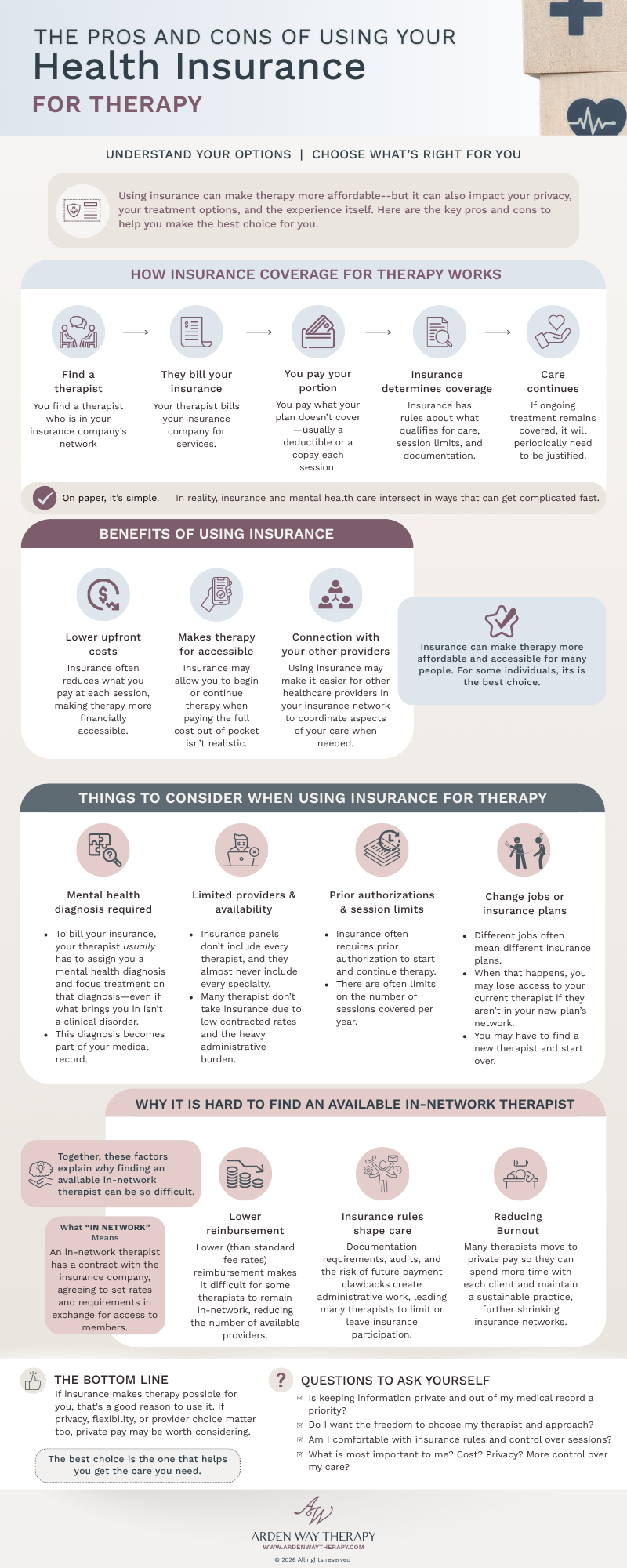
Click here for full blog post on this topic.