
Why Success Doesn't Quiet Your Inner Critic
Written by Krystle Hearley, LMHC
Licensed Mental Health Counselor in New York
Approx. 12-minute read | 🔉 Listen here instead
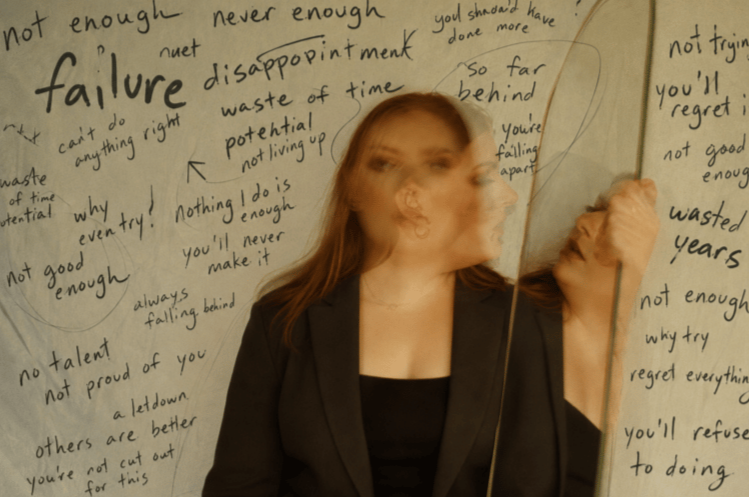
I find that a lot of people believe confidence will arrive after enough success—that once they finally achieve the thing they’ve been working toward, they’ll suddenly feel secure, confident, and enough. There’s this expectation that eventually you’ll reach a point where your mind settles down and says: “There. You made it. You can relax now.”
But I’ve noticed that many people — especially thoughtful, high-functioning, self-aware people — struggle with self-doubt despite their objective success.
Externally, someone may appear confident, capable, accomplished, or emotionally grounded, while internally they’re dealing with:
negative self talk
overthinking
perfectionism and anxiety
chronic self doubt
feeling not good enough
constantly questioning themselves after mistakes
What often surprises people is that finally achieving the thing they worked so hard toward doesn’t quiet their self-doubt like they expected.

Achievement doesn’t quiet the years of self-criticism leading up to it.
Sometimes it actually gives the inner critic more material to work with.
Understanding the Inner Critic
When people hear the phrase “inner critic,” I think they often imagine an obvious internal bully — a loud, dramatic voice frequently insulting them.
And, yes, sometimes it IS that obvious.
But more often, the inner critical voice is quieter and more socially acceptable than that. It can sound responsible. Motivating. Like it’s watching out for you.
Have you ever thought:
“I should be handling this better.”
“Why am I struggling with this?”
“I need to do more.”
“I don’t want to fall behind.”
“I shouldn’t need help.”
“Other people seem to manage this fine.”
The difficult part is that these thoughts can become so familiar that they stop sounding like opinions.
They start feeling true.
That’s something I see often in people struggling with negative self-talk patterns. Negative thinking patterns become automatic over time. Not because they’re accurate, but because they’ve become habituated and familiar. Many people with a harsh inner critic are not people who “hate themselves.” A lot of them are deeply conscientious people who learned very early that being hard on themselves helped them avoid mistakes, rejection, criticism, or disappointment.

My mind has told me all of the above statements at one time or another. I remember frequently thinking, “I should be handling this better.” Looking back, this was during a time when I was experiencing frequent migraines, before doctors knew the multitude of ways migraines impact the body. I saw all of my friends working full-time, or more, and accumulating vacation days. And here I was: frequently calling in sick or leaving early, eager for pay day (not for the paycheck, but for a few more hours to use as needed).
For so long, people drilled into me that “it’s all in your head,” and “you’re making it worse by focusing on it.” I internalized the things people were saying to me, even though they conflicted with how I physically felt. That’s how powerful criticism, or “trying to help,” is.
Reflecting on it now, I can see how much energy I spent criticizing myself for not functioning the way I thought I ‘should,’ instead of recognizing that I was struggling with something real. Now, 10 years later, I’ve finally built a life that helps me navigate my migraines instead of fighting through them. 10 years! And I study this stuff. :)
Why Achievement Doesn't Always Reduce Self-Doubt
Have you ever believed that success will provide you with a sense of emotional security? Essentially, “I can be less hard on myself once I achieve x, y, z.”
It’s a common belief.
It gets ingrained in us through frequent subtle, and some not-so-subtle, messages.
In my experience, achievement and insecurity get entangled from these messages long before adulthood. Many of us began receiving messages in childhood that approval comes through:
performing well
being responsible
making others happy
avoiding mistakes
appearing put together
achieving more
These messages were well-intended BUT pressure-packed.
Sometimes these messages were direct—such as around report card time. And sometimes they developed over time through childhood validation patterns, childhood emotional beliefs, and/or pressure from childhood expectations. From these messages, a person can unconsciously begin believing: “If I do enough, maybe I’ll finally feel enough.”
The problem is… the finish line usually moves.

A person reaches one goal, and instead of relief, their mind shifts toward:
maintaining it
proving they earned it
worrying about losing it
making a new goal that will be “the one” to provide relief
This is where success and perfectionism get emotionally exhausting. Not because achievement itself is unhealthy, but because self-worth becomes dependent on constantly proving your worth. And when a person’s nervous system is operating from “I need to prove I’m good enough,” rest feels uncomfortable. Slowing down triggers guilt. Even positive experiences may get filtered through criticism or comparison.
I think this is part of why high achiever burnout can feel so confusing. You may be truly succeeding while emotionally feeling like you’re constantly failing yourself.
Success and Imposter Syndrome
Imposter syndrome is one of the clearest examples of why success doesn't feel like enough. You can have evidence all around you that you are capable, intelligent, respected, or doing meaningful work… and still feel like you’re falling short somehow. This is because how we feel about ourselves is rarely overruled by evidence. Evidence is objective. But how we feel is subjective and deeply embedded.
If you already have deeply rooted negative self talk or self criticism patterns, the mind can explain away evidence of success very quickly.
A compliment becomes: “They’re just being nice.”
An accomplishment becomes: “I got lucky.”
A success becomes: “Well, but can I maintain it?”
The mistakes get absorbed very differently.
One awkward interaction may replay for days.
One criticism may outweigh ten positive comments.
One imperfect moment may suddenly feel like “proof” of inadequacy.
This doesn’t mean you are weak.
In many ways, the inner critic becomes a coping strategy. If you grew up feeling emotionally unsafe around mistakes, criticism, rejection, or judgment, your brain learns to stay hyper-alert in an effort to avoid those feelings from happening again.
Inner critic anxiety is sometime less worried about achievement itself and more about avoiding emotional discomfort.

I’ve experienced imposter syndrome in my therapy practice. Rationally, the evidence is there to demonstrate my education, experience, and ability. But, sometimes when things are going smoothly for a while, I think to myself, “this can’t be right. I must be missing something. I obviously have more to learn or improve upon.” I’ve now learned to notice, observe, and let those automatic negative thoughts pass. But if I wasn’t aware of those thoughts, they’d keep happening with much more control over me.
The Brain's Relationship With Mistakes
I find it so interesting how the brain can so easily dismiss positive experiences while holding on tightly to negative ones. You can receive overwhelmingly positive feedback and still mentally fixate on the one thing you wish you’d done differently.
You aren’t “being negative” when this happens. Many people’s brains have become conditioned to scan for mistakes because somewhere along the way, mistakes started feeling emotionally unsafe. And we are biologically wired to avoid danger and seek out safety.
The brain stays alert…
Watching.
Adjusting.
Preparing.
Analyzing.
And for some people, self-criticism starts to feel protective.
“If I stay hard on myself, maybe I’ll stay successful.”
“If I criticize myself first, maybe nobody else will.”
“I can’t lower my standards, or I’ll get lazy.”
This is where perfectionism psychology gets tricky. Because…
perfectionism often gets rewarded externally.

People often praise a perfectionism mindset for productivity, responsibility, or achievements without seeing the internal pressure driving it.
Meanwhile, internally, you feel emotionally exhausted from constantly monitoring your own performance.

When the topic of perfectionism comes up, I tend to describe myself as a “recovering perfectionist.” That’s how I see myself. If I had never gained an awareness of how much distress perfectionism causes me, I would still be striving to make everything I touch as best as possible–at the sacrifice of my well-being. Perfectionism is a belief that “when IT is better, I am better.” It’s a way to avoid real or imagined judgement from yourself or others. And it’s mentally exhausting.
Learning to Recognize and Challenge Self-Critical Thoughts
The goal is not to completely eliminate insecurity, negative thoughts, or self-doubt forever. I don’t think that is possible.
The goal is to become more aware of the patterns attached to your thoughts. Why did you have that thought? What did that thought cause you to do? Do you believe that thought? When do those thoughts occur more often? Once you notice the pattern, you gain the ability to question it instead of automatically believing it.
Instead of: “I’m a failure.”
Try: “I’m disappointed with how that went.”
Instead of: “I’m not good enough.”
Try: “I’m struggling with feeling not good enough right now.”
Language matters.
The first statement labeled the entire self.
The second acknowledged a current emotional experience.
Self-compassion often gets a bad rep when misunderstood to mean “letting yourself off the hook.” What I’ve witnessed during self-compassion therapy is that people learn how to remove the shame they feel, NOT their accountability for the situation. There’s a difference between “I made a mistake,” and “I AM a mistake.” And unfortunately, many people blur those together without realizing it.
I’ve come to see many people speak to themselves in ways they would NEVER speak to another person they care about. One of my sayings when it comes to self-compassion is similar to the Golden Rule to ‘treat your neighbor as you want to be treated’:
“treat yourself as well as you treat others.”
Redefining Success
I know redefining success can feel uncomfortable for people who are used to measuring their worth through productivity, achievement, or external validation.
Society reinforces the idea that “more” equals better:
more success
more accomplishments
more productivity
more discipline
more improvement
But eventually, some people start realizing they’ve built a life that looks successful on paper, while still feeling anxious, pressured, emotionally exhausted, and/or disconnected from themselves.
That realization can feel really disorienting—especially for people who spent years believing success would finally create peace. And believing that if their current level of success wasn’t bringing them peace, they must need more of something.
If you want to unlearn that belief, if it’s no longer helping you, here’s a new one to embody:
“I’m not redefining success. I’m expanding on its definition. My version of success is more nuanced than the generic, cookie-cutter definition of success.”

Your version of success can include:
emotional safety
self-trust
healthy relationships
rest
balance
enjoying life’s reality, instead of potential
not constantly feeling at war with yourself
Here are a few perspectives for you to contemplate, or if you journal, journal about:
Maybe a healthy productivity mindset allows room for imperfection.
Maybe a healthy achievement mindset includes compassion alongside growth.
Maybe success isn’t supposed to require constant self-punishment.
Quieting Your Inner Critic Without Losing Yourself
A myth about success is that if you quiet your inner critic, you’ll lose your motivation or determination—that your inner critic is the only thing keeping you productive or successful.
…I’ve actually seen the opposite happen.
When clients become less consumed by shame, fear, overanalysis, and chronic self-monitoring, they often have MORE emotional energy available for meaningful growth. Therapy for inner critic work is not about becoming passive or not caring. It’s about learning how to relate to yourself in a healthier, more sustainable way.
If you recognize yourself in some of these patterns I’ve discussed, try to remember this:
The voice in your head may be familiar…
It may be loud…
And it may sound convincing…
But familiar does not mean truthful.
Life already provides enough unhealthy criticism, pressure, uncertainty, and comparison opportunities. We can all use more allies, not bullies. Start being your own ally.
If this blog resonates with you, and you recognize patterns of chronic self-doubt, perfectionism, people-pleasing, or harsh self-criticism in yourself, you can learn more about my therapy approach for self-doubt and low self-esteem.

Written by Krystle Hearley, LMHC
Krystle is a licensed mental health counselor in New York who specializes in helping thoughtful, high-functioning adults navigate anxiety, self-doubt, overthinking, perfectionism, and people-pleasing patterns. As an expert in pattern-breaking and perspective shifting, she helps clients better understand themselves, challenge long-standing beliefs, and move through life with more self-compassion, clarity, and emotional freedom.